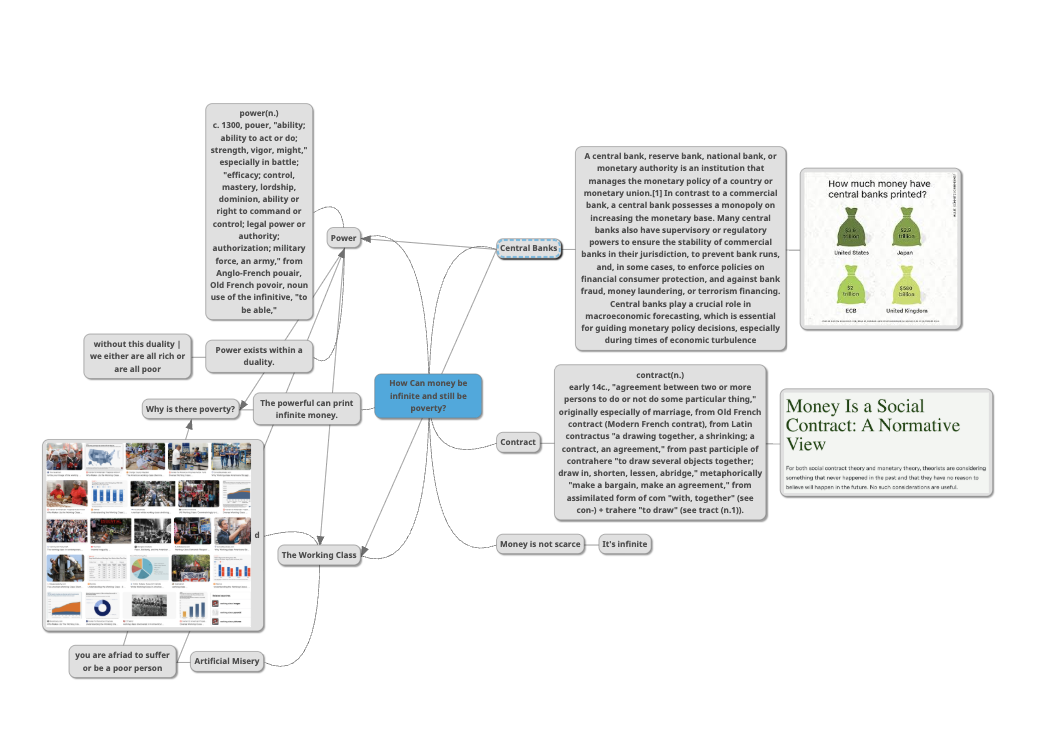
The Paradox: Infinite Money vs. Persistent Poverty

Since central banks can print unlimited money, why does poverty still exist?
Central banks have created trillions of dollars in recent years, yet despite this massive money printing, poverty remains a global issue. Money is not a scarce resource; governments can create it without limit. During the 2020 pandemic, the US Federal Reserve printed about $3.3 trillion. This shows that money can be made infinitely, yet poverty still affects many American Black working-class people. Trillions of dollars flow through financial markets, yet millions of families struggle to meet basic needs. Just as money is created for the 41.7 million people receiving SNAP benefits, we could establish a fund for housing, education, and other essential services. Given that this country has accumulated up to 37 trillion dollars, it suggests that very little, if any, government spending is funded through taxes.
This difference raises questions about how money distribution is managed and the priorities that shape fiscal policies. Despite the ability to create funds, systemic issues such as inequality, lack of access to resources, and financial literacy barriers continue to perpetuate poverty. To effectively address these challenges, a holistic approach that involves not just the allocation of funds but also structural changes may be necessary to ensure equitable access to opportunities and services for all citizens.
Somebody or something controls the flow of money, as shown by the fact that the rich get richer while the poor get poorer. Let’s first assume the government can’t stop printing money, and that money is infinite. Let’s also assume we aim to make it normal for everyone to be rich, which means moving away from this capitalistic system that relies on a wealthy class and a working class. We need to realize that as long as we see money as scarce, we will remain mentally and spiritually constrained. We must first see money as it truly is, limitless, and recognize that we have access to it. To achieve this shift, education and awareness are crucial. We must challenge the conventional ideas about scarcity and value, and foster a mindset that embraces abundance. Only then can we create a society where wealth is not a limited resource but a shared and accessible one for all.
Money is Power
Money has always been tied to power. The LOX named their first album Money, Power & Respect. That phrase alone became a mantra in the culture: first you get the money, then you get the power. Many of us operate with that mindset. Many Black men and women chase the bag above all else, and when they finally get it, they look back like they made the best decision ever.
But here’s the question: does Black wealth automatically translate into Black power? What has really shifted in our communities as more of us have gained access to money? If money itself can be created out of thin air by someone else, a government, a central bank, a system, then maybe the real goal isn’t just to pile up a concept another man invented. At some point, you either become that man (the one creating and controlling the money) or you learn how to live outside of his system altogether.
That choice is scary. Especially if you don’t even realize you’re in a system to begin with.
The Federal Reserve: Money Creation for Whom?
Do American working-class people have access to the Federal Reserve and its policies?
The Federal Reserve and the Illusion of Work
Nobody benefiting from the Federal Reserve is actually working for the money. It’s a severe case of “it’s not what you know, it’s who you know.” The average working man grinds for a paycheck, while the banker or fund manager creates a “vehicle,” a fund, a product, a scheme that magically multiplies wealth. But at the end of the day, they still expect living expenses, homes, and luxuries to be covered by other people’s labor.
And when a financial crisis hits? The Fed doesn’t save the worker. They save the banks, the very same institutions that are supposed to protect the deposits of the working class. In 2008, trillions were poured into Wall Street while ordinary people lost homes and jobs.
The same thing happened again in 2020. The Fed created trillions of dollars to stabilize corporations and financial markets. The working class got a $1,200 stimulus check. But let’s be real: while folks debated how far that check could stretch, billionaires saw their wealth surge by hundreds of billions. Essential workers, the people who kept the country running during lockdowns, were rewarded not with security but with inflation. And the wildest part? Many were told that the workers’ $1,200 checks were to blame for the rising cost of living, not the trillions funneled into markets.
The truth is, the Federal Reserve doesn’t operate with the neediest people in mind. Their business is with the banks, and the banks have no incentive to care about giving regular people money. That means if you don’t “work” in the formal sense or if your work isn’t plugged into the system in the right way, you don’t have real access to money. Meanwhile, there’s a whole class of Americans who rely on you to work precisely so they can hold up the façade of the economy.
Black workers have always been on the sharp end of this arrangement. Historically, Black unemployment has been higher than white unemployment even in so-called good times. And when the Fed raises interest rates to slow the economy, Black workers are the first to lose jobs. Economist William Spriggs put it plainly: when the Fed tightens policy knowing Black unemployment is double that of whites, the attitude is basically, “that’s too bad.”
That’s the social contract of U.S. monetary policy: a permanent class of jobless, disproportionately Black, is tolerated as an “acceptable” trade-off to keep inflation low and protect asset values. Poverty is treated as inevitable, even in a system that can create money without limit.
The Social Contract of Money
Here’s the crazy part about this whole thing: everybody is basically forced to agree that in this system there will always be poor people and rich people. That’s the unspoken deal. Yet we could just as easily imagine and consciously build a system that benefits us all.
Money itself only works because two people agree that it has value. Think about it like this: you’re driving down a road lined with gas stations. You pull into one, and they agree to take your money for gas. That exchange makes your money “real” in that moment. The gas station owner then uses your payment to buy more fuel, pay workers, and keep the lights on. The employees and the vendors also accept the same money, so the game keeps going.
It’s a cycle of agreements. Every store, every business, every bank is part of this constant back-and-forth game. A company that doesn’t play the game, buying and selling, making a profit to cover costs, can’t survive in this system.
But here’s the kicker: if the rules of that game suddenly changed, we’d all look around, confused. That’s because the true purpose of money isn’t just to exchange goods, it’s to maintain an illusion. The illusion that money itself has value. The illusion that those who have it are naturally “above,” and those who don’t deserve to be penalized.
The reality is simple: poverty is not natural. It’s built into this system by design. The rules could be rewritten tomorrow if we wanted them to be. But until we challenge the illusion, the contract stands, and most of us keep playing a game we never got to design in the first place.
Artificial Scarcity
“They got money for wars, but can’t feed the poor.” — Tupac Shakur, Keep Ya Head Up
Look at where the money goes. The proposed U.S. national defense budget for 2026 is set at $1 trillion. Meanwhile, the federal budget for preventing and addressing homelessness sits around $10 billion, with Donald Trump even proposing $532 million in cuts to those programs.
That’s not an accident. That’s a choice.
It’s not that we lack the money, land, or resources needed to solve poverty. America has an abundance. What we lack is the political will, as the system isn’t designed to eliminate poverty. It’s designed to maintain it.
There has to be a certain level of poverty for this system to function the way it does. If poverty were to disappear and everyone had security and options, most people wouldn’t tolerate working for the wages they earn now. The threat of poverty, the fear of slipping into that sector, is what keeps millions of Americans grinding paycheck to paycheck.
Poverty isn’t just an unfortunate byproduct of the system. It’s part of the system. It’s the pressure point that keeps labor cheap, keeps people desperate, and keeps the wheels of the machine turning.
Challenging the Scarcity Mindset
Are you afraid of being poor, or are you working towards financial freedom?
At first, it might sound like the same thing — but these are two very different mindsets.
Fear of poverty will keep you in survival mode. Financial freedom comes from abundance thinking. Knowing how the world works should not defeat you. Even at the highest levels of humanity, leaders rely on intuition, dreams, or spiritual downloads to make decisions. That means wherever you are, you can start with your mindset and align it with universal law.
The law of opulence is tied to reciprocity. Think of it like a gas station. It’s not just the gas, snacks, or oil that bring customers in. It’s the details: the environment, the colors, even small touches that make people feel welcome. There’s a station on 8 Mile and Woodward that sells sage, so whenever I’m around, that’s the one I go to. The product matters, but the issues of energy too.
Abundance is not just about balancing your money to pay bills and stay out of debt. It’s about projecting an environment of more-than-enough. Customers feel that energy when they enter your store, your website, or your presence. To be abundant, you have to invest, look ahead, and trust that people will respond to what you’ve created. You stock inventory with confidence, and you manage your resources with foresight. That mindset creates success more than raw desire ever could.
If your mindset is financial freedom, you’ll assume that reality and act accordingly. But if your mindset is fear of being poor, you’ll seize the first opportunity that comes your way. You’ll take jobs to scrape by. You won’t tap into abundance, because abundance requires a daily practice: giving, circulating, and living with more than enough to share.
That’s why the law of opulence is inseparable from reciprocity. If you offer something of real value, a product, service, or skill, at a fair price, money will naturally flow to you. How you manage that flow determines whether you remain in survival or move toward freedom. If you only make enough to live, you will always need money. But if you invest in your business, in assets, in others, you step into the game of freedom, where money works for you instead of you working for money.
On the metaphysical side, selfishness repels wealth. Holding tightly, refusing to share, keeps money away from you. But when you strive to help others, money finds its way back to you, because reciprocity is a universal law. Your goal shouldn’t be limited to getting rich. It should also help others realize they can be rich, too. That’s how you break scarcity thinking in yourself and in the people around you.
If society truly believed in prosperity for all, we would design policies differently. But even before policy shifts, it starts with us, changing the mindset from fear of lack to confidence in abundance.
So If Money Is Infinite, Why Is There Poverty?
The answer is simple but uncomfortable: poverty exists by design.
Central banks have already shown us money isn’t scarce. They’ve created over $25 trillion since 2008. The U.S. Federal Reserve printed $3.3 trillion in 2020 alone to protect corporations and stabilize financial markets. So clearly, money can be infinite. But while the rich got richer, millions of working-class families, especially Black families, were left juggling rent, food, and bills.
Why? Because money isn’t just paper, it’s power. And power writes the rules of the game. The system is built so that poverty is always present as a threat, as a control mechanism, as the pressure that keeps wages low and workers obedient. Poverty isn’t natural; it isn’t the result of “not enough.” It’s a lever of control.
The paradox dissolves when you see it clearly: money is infinite, but access is limited on purpose.
This is where mindset and metaphysics enter the conversation. If we continue to believe money is scarce, we will keep playing inside the trap that was set for us. But if we recognize money as limitless and start aligning with the law of opulence (reciprocity, circulation, abundance), we step into power. Power to build, power to free ourselves, power to live outside the fear of poverty.
That’s the core of what I teach in Blue Magick: Wealth Magick Handbook and Journal — available now in stores and on Amazon. Blue Magick is about shifting your relationship with money at the mindset, emotional, and spiritual levels. It’s about moving from survival thinking into abundance, not by ignoring the system but by learning how to rise above it.
Because once you stop fearing poverty and start embodying abundance, you stop being controlled by a game you didn’t design. And that is where true power begins.