A Simple Night, a Deeper Feeling
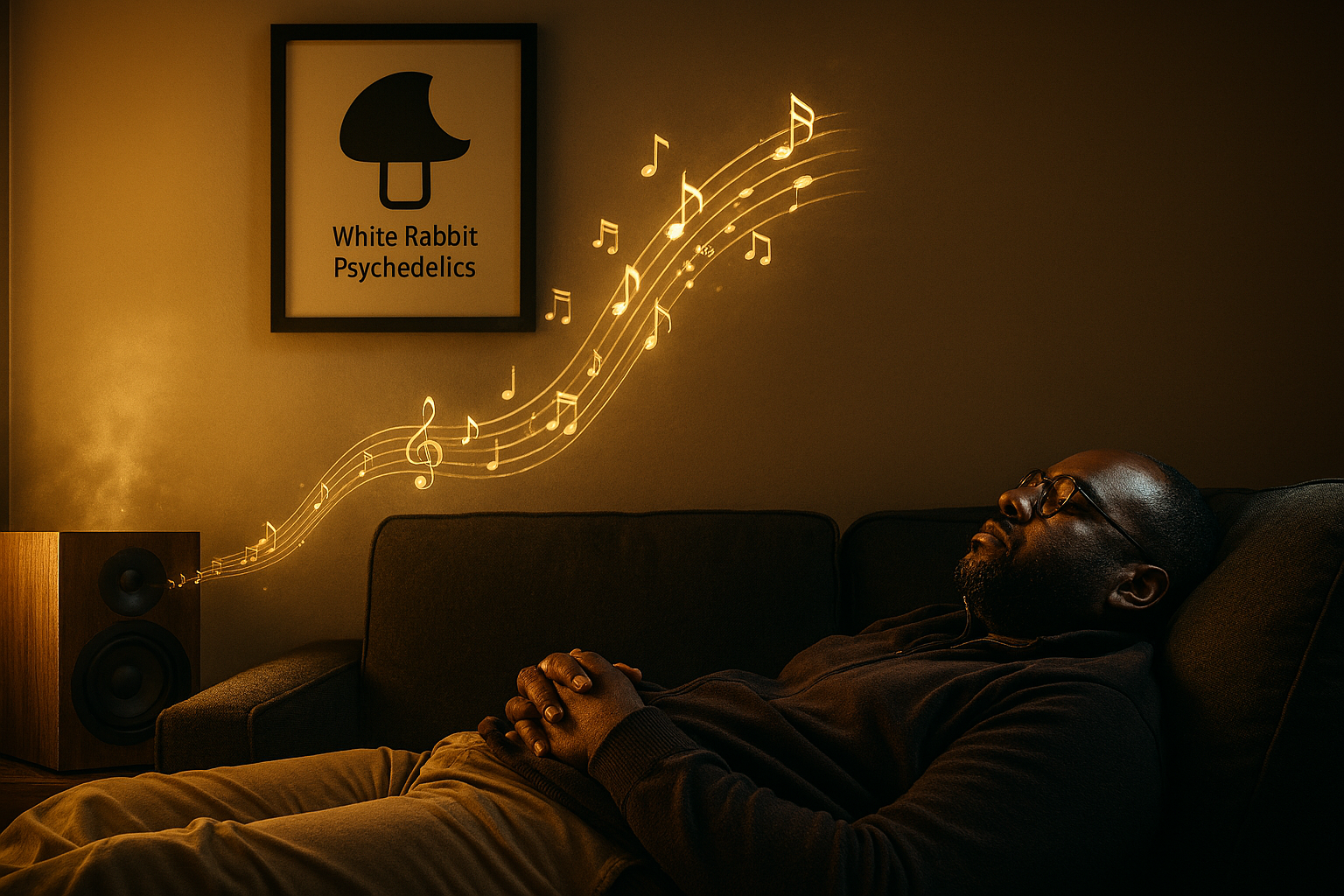
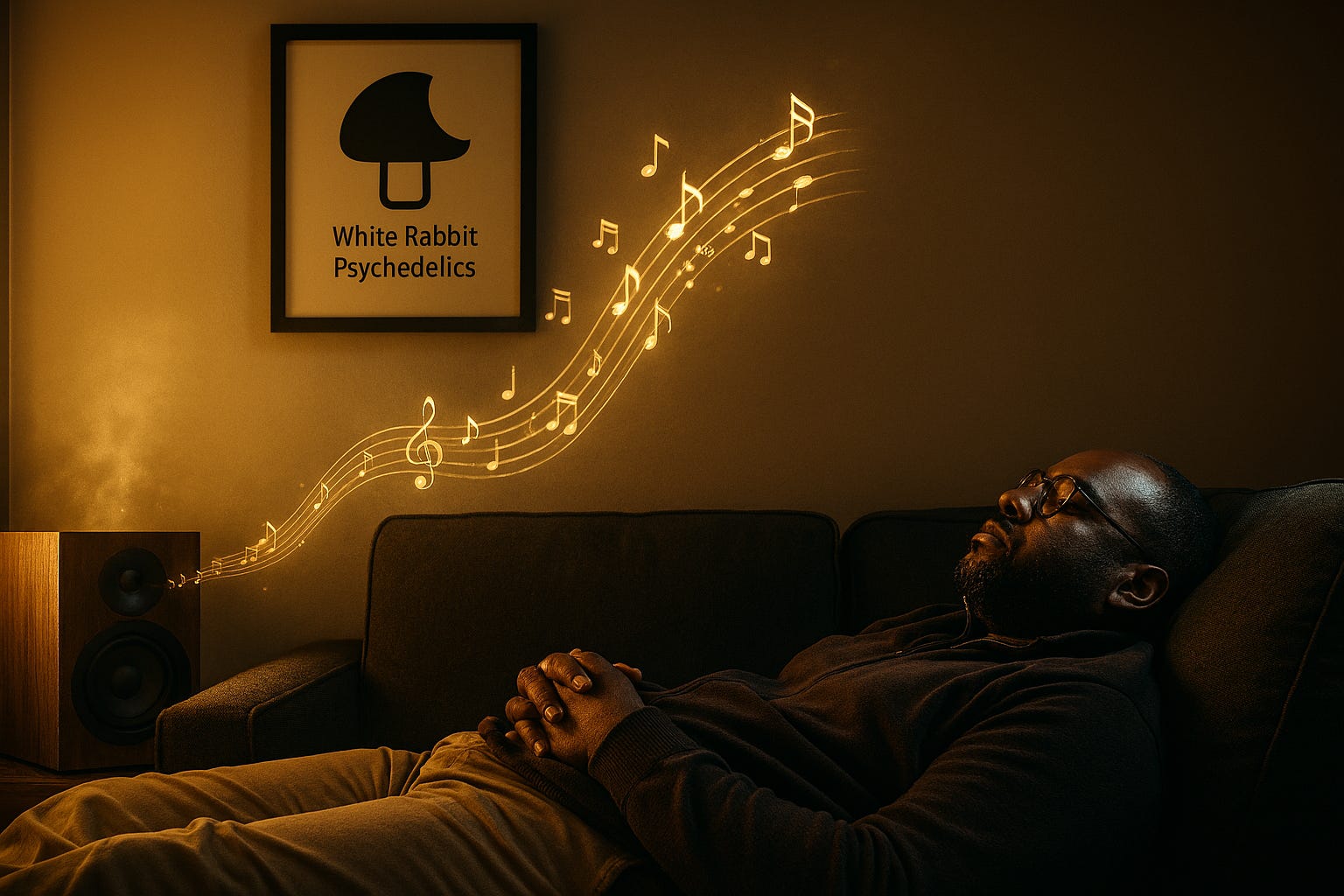
Last night started pretty regularly. I cooked dinner for the kids. They ate, then passed out quickly, and the house went quiet. I heard this Common track play softly in the back of my mind, I must’ve played a thousand times. But I knew what I wanted to do. So I took two pieces of a Mr. Hoodbar, lay down in the living room, and let the album play.
Music As the Medicine
This isn’t the first time I’ve done this, microdosed, pressed play, and just let the music hold me. But something about last night made it click more deeply. There’s a kind of peace that comes from just being with your favorite music, especially when a psychedelic dose softens your mind and body.
It wasn’t about tripping or escaping—it was about medicine. Letting music guide you into yourself. I think many people don’t realize how medicinal this can be. We often discuss set and setting, but we usually overlook sound. Music is the setting, sometimes.
From Anxiety to Alignment
I’ll be real psychedelics still give me some anxiety sometimes. Even with all my experience, there’s this moment of “what now?” after I ingest.

Lately, I’ve been practicing something different. Instead of pushing through or forcing productivity, I let that anxiety guide me to rest or to act.
Last night, it told me to listen. And that made all the difference. The music became my anchor, my therapist, my safe place. It reminded me that I don’t always need to figure things out; sometimes I need to feel them.
Waking Up Different
So this morning, I was up early. Made breakfast with ease. Cleaned up without the usual internal battle. It was one of those rare mornings where everything flowed, and I can’t lie, that’s not always me. I feel I do everything despite my obstacles. Today, I’m reflecting on how my actions create obstacles; now it’s about flowing in the opposite direction.
I credit the music. The space was opened. The peace it offered. That’s what inspired this article. Because, as much as we talk about psychedelics in terms of healing, growth, trauma release, sometimes it’s about receptive moments. Healing doesn’t always look like ceremony or intensity. Sometimes it’s just letting a beat wash over you while you lie on the couch.
Magic Songs and Medicine
In South American indigenous traditions, an Icaro1 is a “magic song, a healing song used during ceremonies. These songs are believed to come from plants, ancestors, or deities. The role of music in psychedelic practices is deeply rooted in these traditions. Music isn’t just background; it’s part of the medicine.
The songs chosen for the ceremony aren’t random. They carry lineage and meaning. And even outside of a ceremony, music can shape your internal state. The loops, rhythms, and tones have the power to influence thought patterns. That’s why it matters what you listen to, especially when your mind is open.
Many people claim they listen to music they like, but what we want often reflects what we’re accustomed to. Sometimes that’s healing. Sometimes it’s not.
Intention, Music, and Psychedelics
The combination of microdosing, music, and mindfulness creates a reliable container for exploration. If you’re looking for a soft entry into psychedelic practice or a way to process the experience gently, music is one of the most accessible tools. The repetition in music acts almost like meditation. It can carry you through the experience without needing to “do” anything.
Works
Santo Daime, founded by Mestre Irineu2, is a religion rooted in an Afro-Brazilian tradition. It began when a man consumed ayahuasca and, after eight days of solitude, started leading spiritual ceremonies with the plant. Many participants reported healing during these gatherings. Lacking written texts, hymns were crafted to convey the teachings and values he received. These ceremonies, often called works, involved hours of silent prayer or singing collectively, all while under the influence of ayahuasca, a plant with psychoactive properties.
The structure of Santo Daime is similar to the Christian church I was raised in, except that any psychedelic substances didn’t consciously influence us. Then again, who knows what was in those communion crackers? As I think about this while writing, I realize that the religious experience might be easier to access when under the influence of a psychedelic dose that expands the mind. For example, a Christian might find that falling asleep listening to a favorite gospel album, while immersing themselves in the word and mind of God, naturally deepens their emotional connection to the divine.
Psychedelic Music
Come to think of it, my first introduction to the concept of psychedelics came through music, specifically psychedelic funk, like Parliament-Funkadelic. I was around 12 when my mom bought me a Best of P-Funk CD, and I played it constantly. I was probably the only kid at school listening to that kind of music, but I’ve always been drawn to sounds that are challenging or hard to replicate. Today, music is made by so many people, which is great for creative expression, but there’s still something to be said about musical genius, and that’s exactly what Parliament was (and still is).
The word psychedelic comes from Greek roots meaning “to reveal the mind,” and in that sense, psychedelic music spans many genres. Some artists create this kind of music intentionally, while others do it unconsciously; however, the result often helps listeners open up to their inner world. Two of my favorite artists—Prince and PM Dawn—have always made music that reveals the mind, although I initially listened to it purely for enjoyment. Later, I realized that what I loved about their sound was how it altered my state of mind. It’s not really about taste—some people won’t connect with those artists—and that’s fine. I’m speaking from a more shamanic or spiritual perspective, where the music, paired with psychedelics, shifts your consciousness in a way that allows healing or self-exploration to occur. During the time I listened to these artists, it was generally during psychedelic experiences, which was wild to discover that their music genre was psychedelic.
In some forms of modern psychedelic therapy, patients wear eyeshades and listen to music as a way to stay focused during their experience3. Because in the modern world, distractions are constant. Based on my own experiences and clinical studies, music has been found to help reduce anxiety and disorientation during your inward journey.
The best analogy I can give—off the top of my head—is this: doing psychedelics without music is like trying to drive a car with your eyes closed. Technically, you could do it, but something essential is missing. In this analogy, music during your dosage is like opening your eyes while driving; it helps you navigate the journey safely and intentionally.
Across culture and history, music has been assigned many different functions, including social, celebratory, medicinal, and with particular frequency, spiritual. Like music, the use of psychedelic drugs is ancient and universal, too, and their usage is tightly intertwined with spirituality.
https://psycnet.apa.org/record/2021-12666-019 | The use of music in psychedelic therapy.
Emotional Receptivity
The reason I mention listening to the song that’s playing in your mind, or just putting on your favorite music, is because of something called emotional receptivity4. Psychedelics let you feel at a deeper level than usual, and that’s probably why some people avoid them. You can’t hide from what you think. Usually, thinking acts like a buffer between you and your emotions. Psychedelics remove that buffer.
In neuroscience, there’s a concept called personal relevance attribution5, which refers to how the brain determines what is essential to focus on. Usually, that means your bills, your stress, and your to-do list are in the foreground, while music, nature, or silence fade into the background. But under a psychedelic, that flips. When the 5-HT2A receptor6 opens, music moves to the center. The lyrics, chord progressions, and sound design become vivid, almost tangible. Music becomes a visual and emotional experience.
This is what researchers call enhanced personal meaning attribution7—and it’s not some vague, poetic idea. It’s biology. Your nervous system, your memory, and your emotional body are all involved. Honestly, this concept didn’t make sense to me until I was in a state of light trance, listening to music, and suddenly broke down crying. Not from sadness. From release. From feeling something I hadn’t let myself feel in years.
Two moments stand out. One was Lalah Hathaway singing live, layering harmonies and singing chords, and it struck something in me that made me ugly cry. The other was Jack Black’s performance of “Mr. Crowley” as a tribute to Ozzy Osbourne. He was backed by a group of kids on instruments, and as the song progressed, the guitar built, and I became increasingly emotional.
That kind of emotional release might sound strange. But to me, it was therapy. I didn’t have $400 an hour to sit with a counselor. What I had was a couple of pieces of chocolate, some good music, and a quiet house. And honestly, I didn’t get any answers. But I didn’t need them. What I got was peace. And sometimes that’s more important than answers.
Music gave me instruction. It guided me. And that’s why I keep coming back to it, not as background noise, but as medicine.
- https://en.wikipedia.org/wiki/Icaro | Icaro ↩︎
- https://en.wikipedia.org/wiki/Santo_Daime | Santo Diame ↩︎
- https://en.wikipedia.org/wiki/Psychedelic_therapy | Pyschedelic Therapy ↩︎
- Emotional receptivity refers to the ability to recognize, understand, and respond positively to the emotions of others. It involves being willing to experience and acknowledge another person’s feelings, even when those feelings differ from your own. This skill is crucial for cultivating strong interpersonal relationships, fostering empathy, and facilitating effective communication. ↩︎
- Personal relevance attribution is when individuals connect external stimuli or information to their lives or self-concept, making it meaningful. This process affects how they perceive, interpret, and respond to information, shaping their thoughts, feelings, and behaviors. ↩︎
- The 5-HT2A receptor was initially noted for its central role as the primary target of serotonergic psychedelic drugs such as LSD and psilocybin mushrooms. It later regained research prominence when found to mediate, at least in part, the effects of many antipsychotic drugs, particularly atypical antipsychotics. ↩︎
- Enhanced personal meaning attribution involves deepening one’s understanding of the causes behind events and behaviors, leading to more positive interpretations. It involves examining both internal (dispositional) and external (situational) influences on our own actions and those of others. This process is especially beneficial in romantic relationships, where understanding and empathy help build trust and resolve conflicts. ↩︎